Download Printer Friendly PDF Version
|
pH / ORP / ISE Process Measurement & Control Systems |
|
Case Study # 9 – Nickel Mining - (January 2004) |
|
Features · Guaranteed Longest Lasting Sensors Available with performance guarantee *
· Sensors are compatible with most existing pH/ORP Meters, Transmitters & Analyzers **
· Application Specific Engineering results in optimum Lifetime & Performance ***
· Integrated Temperature Compensation, Preamplifiers & Solution Ground Elements
· Solid State Reference System offers superior resistance to Fouling & Dehydration
· Applications such as Acid/Fluoride, Hi-Temp, Saturated Sodium and Sulfide Resistant are available as standard options
· Custom Applications are available, often at no additional charge
· Most Installation Styles are Supported Including: Immersion, Twist Lock, Valve Retractable & Sanitary
· Available in a wide range of plastics, from cost effective CPVC to thermally & chemically resilient ULTEM® and PEEK thermoplastic
· High Pressure Applications up to 100 psi for Valve Retractable & 150 psi for Inline Installations can be supported for continuous use
· Operating Temperatures from -30 to +150 ºC (-22 to +302 ºF) can be supported for continuous use |
Case Study No. 9 – pH Control in Nickel Mining
High Temperature Agitated Slurry Nickel Ore Mixtures & Solvent Extractions (SX)
The Problems A nickel mining company wanted to perform pH measurement for sulfide removal by ammonia injection (leaching) and solvent extraction (SX) portions of their nickel extraction operations. The high temperature, heavy agitated slurry mixtures with the presence of dissolved hydrogen sulfide and ammonia gas is quite similar to that which is described in far greater detail in ASTI’s case study # 5 problem section. The solvent extraction process utilizes significant amounts of kerosene, other hydrocarbons and solvents. These extraction agents in combination with the complex slurry ore mixture present a corrosive and aggressive process media for measurement. Previously used sensors required frequent cleaning and recalibration due to organic coating on the sensors. The need for frequent maintenance accelerated the previously used sensor’s demise because the frequent removal from the process resulted in performance degradation due to repeated temperature cycling.
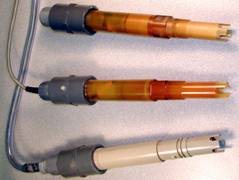
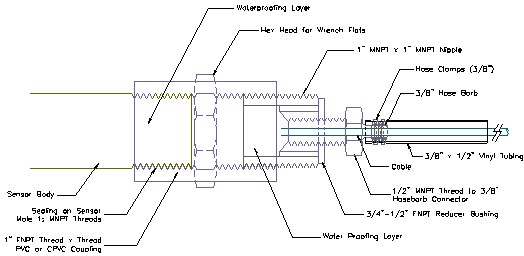
The Solutions The solution to the leaching application is similar to that described in ASTI’s case study # 5 solution section, except that the higher process temperatures and heavier slurry mixture necessitated the use of a thicker walled twist-lock style body from a PEEK material of construction (see further details in pH sensor used for leaching on next page of case study). In addition, a more elaborate cable isolation was required of the waterproofing assembly (Style “B” shown below) due to the deeper submersion installation. The solution to measuring pH in solvent extraction mining processes was the combination of an organic solvent, acid, sulfide and dissolved gas resistant solid state reference system and thick wall, acid, organic and dissolved gas resistant engineered pH element. The proper temperature compensation and preamplifier electronics were integrated into the sensor to allow the retrofit pH sensor to install directly onto the existing explosion proof Rosemount pH transmitter. The maintenance requirements and lifetime of the sensor exceeded the previously used models over three fold, saving operator time and reducing sensor consumption. Hydrocarbon resistant waterproofing style “E” was required to ready the sensor for submersible service.
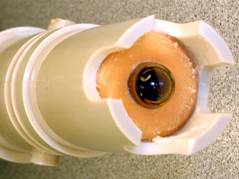
The pH Sensor Used in Leaching: Model: PNCTJHRGR 8141/8441/8641-3081-30 pH Sensor - with Waterproofing Option “B” Description: 1” MNPT Twist Lock (with Tines) PEEK Bodied High Temperature, Sulfide, Dissolved Gas and Hysteresis Resistant pH Sensor with Triple Junction reference system; Integrated 100 Ohm Platinum Temperature Element; 30 feet cable to connect directly to Rosemount 3081 pH Analyzer/Transmitter – with Waterproofing Option “B” (Shown Below)
The pH Sensor Used in Solvent Extraction (SX): Model: PNCLTS 8431/8631-2081-25 pH Sensor - with Waterproofing Option “E” Description: 1” MNPT Twist Lock (with Tines) PEEK Bodied High Temperature, Sulfide, Dissolved Gas, Solvent and Organic Media and Hysteresis Resistant pH Sensor with Triple Junction reference system; Integrated 100 Ohm Platinum Temperature Element; 30 feet cable to connect directly to Rosemount 3081 pH Analyzer/Transmitter – with Waterproofing Option “E” Waterproofing Engineering for Solvent Extraction SX Environments (Shown Below)
Choosing the Correct pH/ORP Sensor 1. Choose a sensor body type that suits the physical parameters of the installation (refer to the Configurations Portion of pH/ORP and Ion Selective webpages). 2. Choose a sensor that suits the process application, temperature, chem istry, and physical parame ters of the installation (refer to Sensor Selection Guides and call factory or local sales agent for support) 3. Choose a sensor housing material that is compatible with the process chemistry, temperature & pressure (refer to Chemical Resistance Charts as posted under the Technical Documents portion of the website). 4. Select suitable temperature compensation element, solution ground & integrated preamplifier based upon the mating pH/ORP Instrument (refer to Electrochemical Instrumentation Page & ask for factory support). 5. Specify the required cable length based upon installation location (refer to Part Numbering Guide).
* Subject to application qualification and review by an approved ASTI sales agent and/or factory. Performance guarantee is posted on the ASTI online application questionnaire page. ** See list of supported pH/ORP/ISE Instruments webpages as posted on the ASTI website. *** Completion of Application Questionnaire form is required. Other restrictions may apply. |
||||