Download Printer Friendly PDF Version
|
pH / ORP / ISE Process Measurement & Control Systems |
|
Case Study # 8 – Total Cyanide Monitoring - (January 2004) |
|
Features · Guaranteed Longest Lasting Sensors Available with performance guarantee *
· Sensors are compatible with most existing pH/ORP Meters, Transmitters & Analyzers **
· Application Specific Engineering results in optimum Lifetime & Performance ***
· Integrated Temperature Compensation, Preamplifiers & Solution Ground Elements
· Solid State Reference System offers superior resistance to Fouling & Dehydration
· Applications such as Acid/Fluoride, Hi-Temp, Saturated Sodium and Sulfide Resistant are available as standard options
· Custom Applications are available, often at no additional charge
· Most Installation Styles are Supported Including: Immersion, Twist Lock, Valve Retractable & Sanitary
· Available in a wide range of plastics, from cost effective CPVC to thermally & chemically resilient ULTEM® and PEEK thermoplastic
· High Pressure Applications up to 100 psi for Valve Retractable & 150 psi for Inline Installations can be supported for continuous use
· Operating Temperatures from -30 to +150 ºC (-22 to +302 ºF) can be supported for continuous use |
Case Study No. 8 – Total Cyanide Determination in Gold Mining
Rugged pH and Cyanide Ion Selective Mining Sensors for Gold Leach Applications
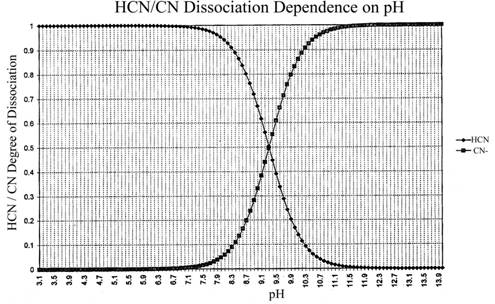
The Problem A gold mining company wanted to reduce the expenditures on their leaching bath and improve their gold recovery. Gold recovery through a cyanide complexation process has long been a staple of the gold ore mining industry. There are serious hazards associated with this process, many of which can be reduced by accurate aqueous process control. Improved product yield, reduced dangers to the plant workers and the environment at large are benefit of better process control. Below a pH of approximately 9.5, free cyanide begins to evolve into hydrogen cyanide gas, which is a toxic compound. The control of pH is critical to maintaining a safe and cost effective extraction process. Due to the natural buffering action of very hard water (dissolved calcium and magnesium salts), it is a very expensive process to raise the pH higher than 10.5. This leaves only a small margin for error in pH process control. The complexation capability of a cyanide solution is determined by the total cyanide present, not just the free or ionized species. A control system capable of determining the total HCN was required. Cyanide solutions quickly attack pH glass and render them inoperable. Since the solution was comprised of a thick slurry constantly stirred ore solution, a build-up upon the pH and reference element caused short sensor lifetime. The small amount of liberated gas attacked the reference and ion sensing elements. No previous cyanide ion selective sensor had survived for any usable period in this process.
The Solution A dual channel analyzer which was capable of computing and outputting a 4-20 mA signal for the total HCN content and pH value. The use of a thick walled 1” Twist Lock body housing mounted via a 1” MNPT standpipe reduced breakage of the body. The pH sensor was specially designed to work in harsh conditions. It was constructed of a cyanide resistant pH element and a reference, sealed against both ionic and gaseous attack. The slurry/viscous material resistant pH glass reduced down time and maintenance costs through reduced breakage. The poly-crystalline cyanide ion selective sensor was designed specifically for a gold leaching application. This cyanide ion selective sensor was much less susceptible to the membrane erosion and dissolving than most cyanide sensors. The new cyanide ion sensor required less calibration and cleaning of the membrane. The process run safer and more efficiently than before, saving money and reducing employee maintaining the cyanide process control system. Specially formulated calibrations solution improved accuracy and solved the problem of incongruities between laboratory titrations and process measurements. Once consistency between process and laboratory measurement was established, remote one-point calibrations were performed based upon titration results, after initial determination of sensor span (two-point calibration). Remote one-point calibrations reduced costs by avoiding dangerous and time consuming sensor cleaning and calibration on-site.
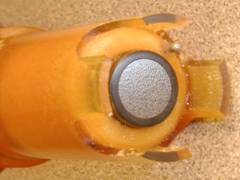
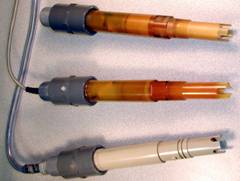
The Cyanide Ion Sensor Used: Model: ABGTJ 8160-PT91-25 Cyanide Ion Sensor – with Waterproofing Option “C” Description: 1” MNPT Twist Lock (with tines) ULTEM Cyanide Ion Selective Sensor with Triple Junction Reference (Gold Heap Leach Mining); Integrated 3000 Ohm Balco Temperature Compensator, Stainless Steel Solution Ground and ASTI PT91 compatible preamplifier; 25 feet cable to connect directly to Special Order ASTI PT91 (Dual Channel Auto pH Compensation) pH/ISE Analyzer/Transmitter (Also Available for Cyanide Tailings Monitoring Applications)
The pH Sensor Used: Model: PNCTJ 8631-PT91-25 pH Sensor – with Waterproofing Option “C” Description: 1” MNPT Twist Lock (with tines) ULTEM Dissolved Gas and Sulfide Resistant pH Sensor with Triple Junction Reference; Integrated 3000 Ohm Balco Temperature Compensator, Stainless Steel Solution Ground and ASTI PT91 compatible preamplifier; 25 feet cable to connect directly to Special Order ASTI PT91 (Dual Channel) pH/ISE Analyzer/Transmitter
Choosing the Correct pH/ORP Sensor 1. Choose a sensor body type that suits the physical parameters of the installation (refer to the Configurations Portion of pH/ORP and Ion Selective webpages). 2. Choose a sensor that suits the process application, temperature, chem istry, and physical parame ters of the installation (refer to Sensor Selection Guides and call factory or local sales agent for support) 3. Choose a sensor housing material that is compatible with the process chemistry, temperature & pressure (refer to Chemical Resistance Charts as posted under the Technical Documents portion of the website). 4. Select suitable temperature compensation element, solution ground & integrated preamplifier based upon the mating pH/ORP Instrument (refer to Electrochemical Instrumentation Page & ask for factory support). 5. Specify the required cable length based upon installation location (refer to Part Numbering Guide).
* Subject to application qualification and review by an approved ASTI sales agent and/or factory. Performance guarantee is posted on the ASTI online application questionnaire page. ** See list of supported pH/ORP/ISE Instruments webpages as posted on the ASTI website. *** Completion of Application Questionnaire form is required. Other restrictions may apply. |
||||