Download Printer Friendly PDF Version
|
pH / ORP / ISE Process Measurement & Control Systems |
|
Case Study # 6 – Acid HF Etching Control - (January 2004) |
|
Features · Guaranteed Longest Lasting Sensors Available with performance guarantee *
· Sensors are compatible with most existing pH/ORP Meters, Transmitters & Analyzers **
· Application Specific Engineering results in optimum Lifetime & Performance ***
· Integrated Temperature Compensation, Preamplifiers & Solution Ground Elements
· Solid State Reference System offers superior resistance to Fouling & Dehydration
· Applications such as Acid/Fluoride, Hi-Temp, Saturated Sodium and Sulfide Resistant are available as standard options
· Custom Applications are available, often at no additional charge
· Most Installation Styles are Supported Including: Immersion, Twist Lock, Valve Retractable & Sanitary
· Available in a wide range of plastics, from cost effective CPVC to thermally & chemically resilient ULTEM® and PEEK thermoplastic
· High Pressure Applications up to 100 psi for Valve Retractable & 150 psi for Inline Installations can be supported for continuous use
· Operating Temperatures from -30 to +150 ºC (-22 to +302 ºF) can be supported for continuous use |
Case Study No. 6 – pH & Fluoride Measurement in Acid Etching
A system to determine and control the acid etching strength of a given process solution
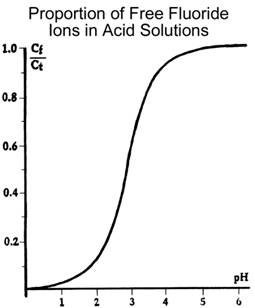
The Problem A metal etching company needed to control the power of its fluoride etching bath. The quality of the etching solution depends on the activity of the fluoride and pH. The throughput depends on the total fluoride concentration of the bath and the speed of the line. Fluctuations in the fluoride activity will result in the incomplete etching of the parts, preventing further processing and the partial or complete dissolution of the aluminum parts. Since free fluoride ion concentration is a function of pH, they needed to monitor both the pH and fluoride ion concentration in order to properly control their bath.
Most commercially available pH sensors will be dissolved by fluorides. While the process is progressing, a crust is deposited on the surface of the pH and junction element reducing the sensitivity and elongating response time. The elimination of this phenomenon requires frequent cleaning and calibration that will eventually destroy the pH element. The large quantity of etching solution passing by the sensor will exhaust the reference element of its internal salts and cause constant drifting, thus requiring recalibration. The fluoride element used in these types of measurements also will be attacked by the acid/fluoride mixture. The acid is needed to activate the fluoride for the etching process. The acid also influences the available free fluorides and changes the readings in the control system. The fluoride ion selective sensors employed suffered many of the same difficulty as the pH sensors result in poor and sporadic process control.
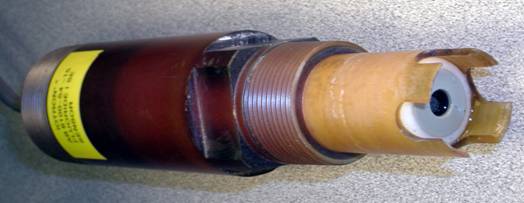
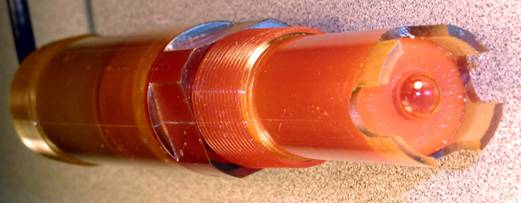
The Solution The pH sensor employed a specially constructed high acid/fluoride resistant pH element with acid/fluoride resistant solid state reference junction. The sensor was embedded with the appropriate temperature compensator and Rosemount compatible preamplifier such that it connected directly into the existing pH transmitter. The fluoride ion activity was measured with a fluoride ion selective sensor with a special engineering against the attack of the etching mixture. The protection against the process etching solution was accomplished via a special gasket for the fluoride crystal designed for this customer’s application and a customized acid/fluoride resistant reference junction which did not undergo the shifting common to high ionic strength solutions.
This fluoride sensor also contained the appropriate temperature compensator and preamplifier for the existing fluoride transmitter. The accuracy and control of the measurement increased leading to product quality and production rate increases. The need for cleaning and frequent calibrations was nearly completely eliminated. Calibrations were perform for offset only (one-point), done via grab sample. The sensor lifetimes were vastly extended resulting in excellent cost savings.
Choosing the Correct pH/ORP Sensor 1. Choose a sensor body type that suits the physical parameters of the installation (refer to the Configurations Portion of pH/ORP and Ion Selective webpages). 2. Choose a sensor that suits the process application, temperature, chem istry, and physical parame ters of the installation (refer to Sensor Selection Guides and call factory or local sales agent for support) 3. Choose a sensor housing material that is compatible with the process chemistry, temperature & pressure (refer to Chemical Resistance Charts as posted under the Technical Documents portion of the website). 4. Select suitable temperature compensation element, solution ground & integrated preamplifier based upon the mating pH/ORP Instrument (refer to Electrochemical Instrumentation Page & ask for factory support). 5. Specify the required cable length based upon installation location (refer to Part Numbering Guide).
* Subject to application qualification and review by an approved ASTI sales agent and/or factory. Performance guarantee is posted on the ASTI online application questionnaire page. ** See list of supported pH/ORP/ISE Instruments webpages as posted on the ASTI website. *** Completion of Application Questionnaire form is required. Other restrictions may apply. |
||||