Download Printer Friendly PDF Version
|
pH / ORP / ISE Process Measurement & Control Systems |
|
Case Study # 4 – Organic Solvent Recovery - (January 2004) |
|
Features · Guaranteed Longest Lasting Sensors Available with performance guarantee *
· Sensors are compatible with most existing pH/ORP Meters, Transmitters & Analyzers **
· Application Specific Engineering results in optimum Lifetime & Performance ***
· Integrated Temperature Compensation, Preamplifiers & Solution Ground Elements
· Solid State Reference System offers superior resistance to Fouling & Dehydration
· Applications such as Acid/Fluoride, Hi-Temp, Saturated Sodium and Sulfide Resistant are available as standard options
· Custom Applications are available, often at no additional charge
· Most Installation Styles are Supported Including: Immersion, Twist Lock, Valve Retractable & Sanitary
· Available in a wide range of plastics, from cost effective CPVC to thermally & chemically resilient ULTEM® and PEEK thermoplastic
· High Pressure Applications up to 100 psi for Valve Retractable & 150 psi for Inline Installations can be supported for continuous use
· Operating Temperatures from -30 to +150 ºC (-22 to +302 ºF) can be supported for continuous use |
Case Study No. 4 – pH in Organic Solvent Recovery Systems
pH measurement in almost pure (99%) Organic Solvents & Solvent Recovery Systems
The Problem
A manufacturer of organic chemicals required process control equipment for its solvent recovery system. This process consisted of the collection of the used solvents and the storage of a mixture consisting of fractional distillations. The solvents accumulated some water during the process, this water extracted acids or alkali from the product and was carried into the storage tank. Since there was only a small amount of water, the concentration of the resulting acids and alkali was very high. In some cases, the small percentage of water was so corrosive that the stainless steel tank was attacked and the solvents leaked into the atmosphere. Repeated attempts to measure the pH value failed because the solvent mixture either dissolved the sensor or attacked the reference junction making it inoperable. The rapid and sometimes unpredictable fluctuations in pH made accurate readings difficult. Due to electrical consideration and area classification rules, an integrated preamplifier was required to get stable usable potentials from the pH sensor.
The Solution
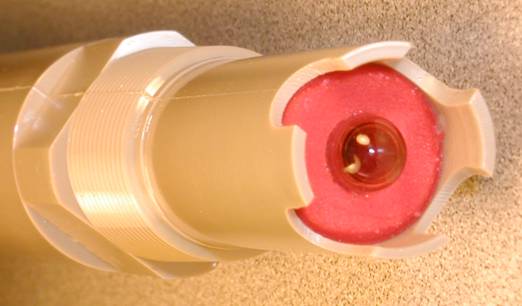
What was required was a sensor that was constructed of components that are impervious to the wide variety of process chemicals employed. This was accomplished by use of a wide range thick wall pH glass element, a solvent media resistant solid state reference junction and an immersion PEEK sensor body housing. The necessary temperature compensator, solution ground and preamplifier where embedded into the sensor as required for the area classification. This custom engineered pH sensor provided a reliable, fast responding and accurate measurement in the extreme acid and alkali environment found in the organic solvent recovery system.
The pH Sensor Used:
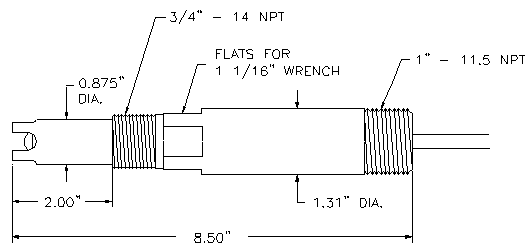
Model: PNLTS 6041/6441-870IT-10 pH Sensor Description: ¾”- 1” MNPT Immersion PEEK Bodied Organic & Solvent Media Resistant Wide Range Acid/Fluoride Resistant pH Sensor; Integrated 1000 Ohm Platinum Temperature Element, Stainless Steel Solution Ground and Foxboro Compatible 870IT preamplifier; 10 feet cable to connect directly to Foxboro 870IT pH Analyzer/Transmitter
Choosing the Correct pH/ORP Sensor
1. Choose a sensor body type that suits the physical parameters of the installation (refer to the Configurations Portion of pH/ORP and Ion Selective webpages). 2. Choose a sensor that suits the process application, temperature, chem istry, and physical parame ters of the installation (refer to Sensor Selection Guides and call factory or local sales agent for support) 3. Choose a sensor housing material that is compatible with the process chemistry, temperature & pressure (refer to Chemical Resistance Charts as posted under the Technical Documents portion of the website). 4. Select suitable temperature compensation element, solution ground & integrated preamplifier based upon the mating pH/ORP Instrument (refer to Electrochemical Instrumentation Page & ask for factory support). 5. Specify the required cable length based upon installation location (refer to Part Numbering Guide).
* Subject to application qualification and review by an approved ASTI sales agent and/or factory. Performance guarantee is posted on the ASTI online application questionnaire page. ** See list of supported pH/ORP/ISE Instruments webpages as posted on the ASTI website. *** Completion of Application Questionnaire form is required. Other restrictions may apply. |
||