Download Printer Friendly PDF Version
|
pH / ORP / ISE Process Measurement & Control Systems |
|
Case Study # 13 – Fluoride Ion Monitoring - (January 2004) |
|
Features · Guaranteed Longest Lasting Sensors Available with performance guarantee *
· Sensors are compatible with most existing pH/ORP Meters, Transmitters & Analyzers **
· Application Specific Engineering results in optimum Lifetime & Performance ***
· Integrated Temperature Compensation, Preamplifiers & Solution Ground Elements
· Solid State Reference System offers superior resistance to Fouling & Dehydration
· Applications such as Acid/Fluoride, Hi-Temp, Saturated Sodium and Sulfide Resistant are available as standard options
· Custom Applications are available, often at no additional charge
· Most Installation Styles are Supported Including: Immersion, Twist Lock, Valve Retractable & Sanitary
· Available in a wide range of plastics, from cost effective CPVC to thermally & chemically resilient ULTEM® and PEEK thermoplastic
· High Pressure Applications up to 100 psi for Valve Retractable & 150 psi for Inline Installations can be supported for continuous use
· Operating Temperatures from -30 to +150 ºC (-22 to +302 ºF) can be supported for continuous use |
Case Study No. 13 – Fluoride Ion Monitoring in Drinking Water and Water Applications (or non Acid/Etching Wastewater)
Online Fluoride Ion Monitoring for Water Districts and other Water Authorities
The Problem
A water district was required to monitor the levels of fluoride in the city drinking water supply. If the levels were too low, fluoride was required to be added. If fluoride levels were too high, fluoride must be removed. Because of the natural temperature variance at the measurement point, the existing sampling fluoride analyzer gave erratic results. The constant requirement of adding reagents to the sampling analyzer placed a high burden on the busy maintenance staff, and resulted in reduced plant efficiency. When the problems with the sampling fluoride analyzer could not be addressed, grab sample analysis was used. The use of constant grab sample during times of problems with the online equipment created an undue burden on the maintenance staff, and defeated the purpose of having an online fluoride monitoring system.
Since multiple measurement points were required, a complex system of piping was installed to deliver sample to the few sampling analyzer available. One a few sampling analyzer were installed due to their prohibitively high cost. This caused the two fold problem of a delay in the measurement due to the piping of the sample to the analyzer (not real time) and the centralization cause the entire system to go down at once when problems occurred with any of the few analyzers that were installed.
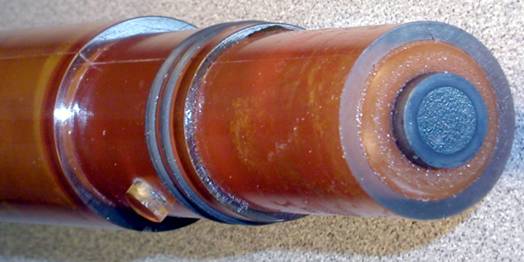
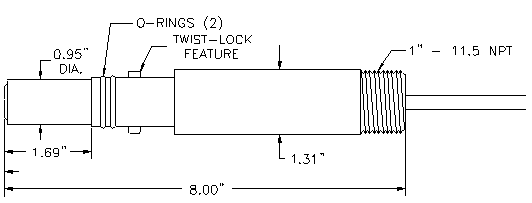
The Solution An inline fluoride ion selective sensor, specially engineered to water and wastewater application was chosen, with a rugged fluoride mono-crystal ion sensing element, and a virtually maintenance solid state reference system. In order to optimize the stability of the inline fluoride sensor measurement, a low flow sample bypass system was employed. A menu driven, simple to use, industrial ion selective transmitter and analyzer that was capable of calibrating, displaying, outputting and controlling in ppm units was selected. A convenient bayonet style twist lock inline installation style was selected for its ease of removal, facilitating the required calibration and cleaning. Calibration solutions were formulated that were ten fold (one decade) apart in value and would bracket the target concentration range. The calibration solutions were designed to closely mimic the expected ionic background of the measured solution. The calibration system simplified the validation of the online fluoride analysis system and reduced the need for grab sample calibration all while replacing the cumbersome sampling fluoride analyzer.
The Fluoride Sensor Used:
Model: AB 8100-100-10 Fluoride Ion Selective Sensor Description: 1” MNPT Twist Lock (Quick Disconnect) ULTEM Bodied Fluoride Ion Selective Sensor; Integrated 100 Ohm Platinum Temperature Element; 10 feet cable to connect directly to Rosemount 54e-ISE Analyzer/Transmitter/Controller
Choosing the Correct pH/ORP/ISE Sensor
1. Choose a sensor body type that suits the physical parameters of the installation (refer to the Configurations Portion of pH/ORP and Ion Selective webpages). 2. Choose a sensor that suits the process application, temperature, chem istry, and physical parame ters of the installation (refer to Sensor Selection Guides and call factory or local sales agent for support) 3. Choose a sensor housing material that is compatible with the process chemistry, temperature & pressure (refer to Chemical Resistance Charts as posted under the Technical Documents portion of the website). 4. Select suitable temperature compensation element, solution ground & integrated preamplifier based upon the mating pH/ORP Instrument (refer to Electrochemical Instrumentation Page & ask for factory support). 5. Specify the required cable length based upon installation location (refer to Part Numbering Guide).
* Subject to application qualification and review by an approved ASTI sales agent and/or factory. Performance guarantee is posted on the ASTI online application questionnaire page. ** See list of supported pH/ORP/ISE Instruments webpages as posted on the ASTI website. *** Completion of Application Questionnaire form is required. Other restrictions may apply. |
||