Download Printer Friendly PDF Version
|
pH / ORP / ISE Process Measurement & Control Systems |
|
Case Study # 10 – Bleaching in Pulp Mills - (January 2004) |
|
Features · Guaranteed Longest Lasting Sensors Available with performance guarantee *
· Sensors are compatible with most existing pH/ORP Meters, Transmitters & Analyzers **
· Application Specific Engineering results in optimum Lifetime & Performance ***
· Integrated Temperature Compensation, Preamplifiers & Solution Ground Elements
· Solid State Reference System offers superior resistance to Fouling & Dehydration
· Applications such as Acid/Fluoride, Hi-Temp, Saturated Sodium and Sulfide Resistant are available as standard options
· Custom Applications are available, often at no additional charge
· Most Installation Styles are Supported Including: Immersion, Twist Lock, Valve Retractable & Sanitary
· Available in a wide range of plastics, from cost effective CPVC to thermally & chemically resilient ULTEM® and PEEK thermoplastic
· High Pressure Applications up to 100 psi for Valve Retractable & 150 psi for Inline Installations can be supported for continuous use
· Operating Temperatures from -30 to +150 ºC (-22 to +302 ºF) can be supported for continuous use |
Case Study No. 10 – Bleaching in Pulp Mills
pH and ORP sensors as used for process control in bleaching operations at Pulp Mills
The Problem A pulp and paper producer wanted to improve their control and reduce their maintenance time and costs for their ClO2 bleaching process lines. They wanted to better control the brightness of the resultant pulp and reduce down time due to pH and ORP sensor failure and cleaning requirements. This meant that they were replacing their sensor every 1-2 months and cleaning and calibrating bi-weekly.
Conventional pH/ORP sensors experienced fast intrusion into the reference element due to the high temperature (from 100 to 150 ºC, 212 to 302 ºF) and pressure (50 to 100 psi) in the presence of high concentrations of chlorine dioxide gas. Previously used pH and ORP sensors required frequent calibrations due the drift of the reference element. The strong bleaching agent attacked both the sensor’s internal “O”-rings and other external “O”-rings that sealed it to the titanium sheath. Failure of these “O”-rings permitted the dangerous process gas to intermittently escape intermittently during removal and insertion of the multi-component valve retractable sensor assembly. The sealing agent for the junction and pH components were dissolved and eroded, allowing the gas to intrude all the way through the reference element and to the back of the sensor.
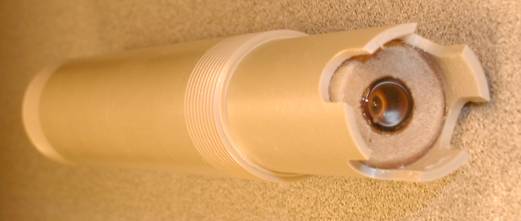
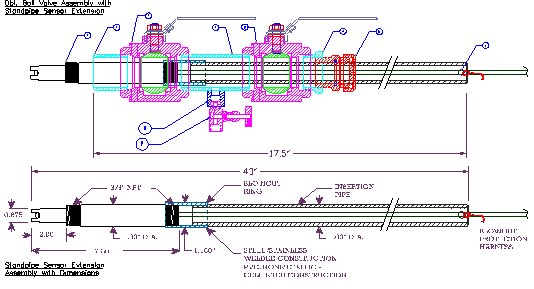
The Solution The hardware solution was the use of a 316 stainless steel, complete isolation double ball valve sensor retraction and insertion assembly. The sensor solution incorporated dissolved gas (chlorine dioxide) and slurry/viscous material resistant pH and ORP components. These sensors were sealed from the front and back end with agents that were selected based upon the chemicals and process conditions present. The non-porous cross-linked high-density conductive polymer triple junction reference system did not allow for the chlorine dioxide to diffuse in the junction thus extending the lifetime of the sensor five-fold. The frequency of calibration was significantly reduced as well as the drift of the reference signal. The single unit, completely sealed, “O”-ring free design sensor design allowed the high grade thermoplastic (ULTEM and PEEK) sensor body housed ¾”-¾” MNPT immersion sensors to be installed directly into the double ball valve retraction assembly. This significantly reduced maintenance time required, eliminating the need for disassembly and re-assembly of insertion sheaths (unlike other manufacturer’s multi-component valve retractable designs). The safety of operating the double ball valves improved by removing the possibility of “O”-ring seal through ASTI’s “O”-ring free design. The required temperature compensation element was embedded directly into the sensor, permitting the cable to be connected directly from the back of the sensor in the original equipment manufacturer’s (OEM) transmitter. In this way, the company was able to leave the process control loop in place, yet greatly improve the quality of their process through superior pH & ORP sensor performance and lifetime.
The pH Sensor Used: Model: PNCTJ 6342-3000-15 pH Sensor Description: ¾”- ¾” MNPT Immersion PEEK Bodied Slurry/Viscous Material and Dissolved Chlorine Gas Resistant pH Sensor with Triple Junction reference system; Integrated 3000 Balco Temperature Element; 15 feet cable to connect directly to TBI-Bailey-ABB pH Transmitter
The ORP Sensor Used: Model: PNCTJ 6842-0000-15 ORP Sensor Description: ¾”- ¾” MNPT Immersion PEEK Bodied Slurry/Viscous material and Dissolved Chlorine Gas Resistant ORP Sensor with Triple Junction reference system; No Temperature Element; 15 feet cable to connect directly to TBI-Bailey-ABB ORP Analyzer/Transmitter
Choosing the Correct pH/ORP Sensor 1. Choose a sensor body type that suits the physical parameters of the installation (refer to the Configurations Portion of pH/ORP and Ion Selective webpages). 2. Choose a sensor that suits the process application, temperature, chem istry, and physical parame ters of the installation (refer to Sensor Selection Guides and call factory or local sales agent for support) 3. Choose a sensor housing material that is compatible with the process chemistry, temperature & pressure (refer to Chemical Resistance Charts as posted under the Technical Documents portion of the website). 4. Select suitable temperature compensation element, solution ground & integrated preamplifier based upon the mating pH/ORP Instrument (refer to Electrochemical Instrumentation Page & ask for factory support). 5. Specify the required cable length based upon installation location (refer to Part Numbering Guide).
* Subject to application qualification and review by an approved ASTI sales agent and/or factory. Performance guarantee is posted on the ASTI online application questionnaire page. ** See list of supported pH/ORP/ISE Instruments webpages as posted on the ASTI website. *** Completion of Application Questionnaire form is required. Other restrictions may apply. |
||